No, a set cannot have more than 4 cards in Rummy. A valid set is formed from cards of the exact same rank but completely different suits, and since a standard 52-card deck only has four suits (Hearts, Spades, Clubs, Diamonds), the maximum number of natural cards in any set is four. For example, a grouping like 9♥ 9♠ 9♦ 9♣ is the largest possible natural set you can legally make. Attempting to add a fifth card would force you to duplicate a suit, which instantly makes the set invalid.
Understanding this core rule is one of the most important steps for beginners in South Asia. Many new players struggle with card limits, which often leads to invalid declarations and heavy penalty points. Therefore, learning the boundaries of a valid set will save you from unnecessary losses.
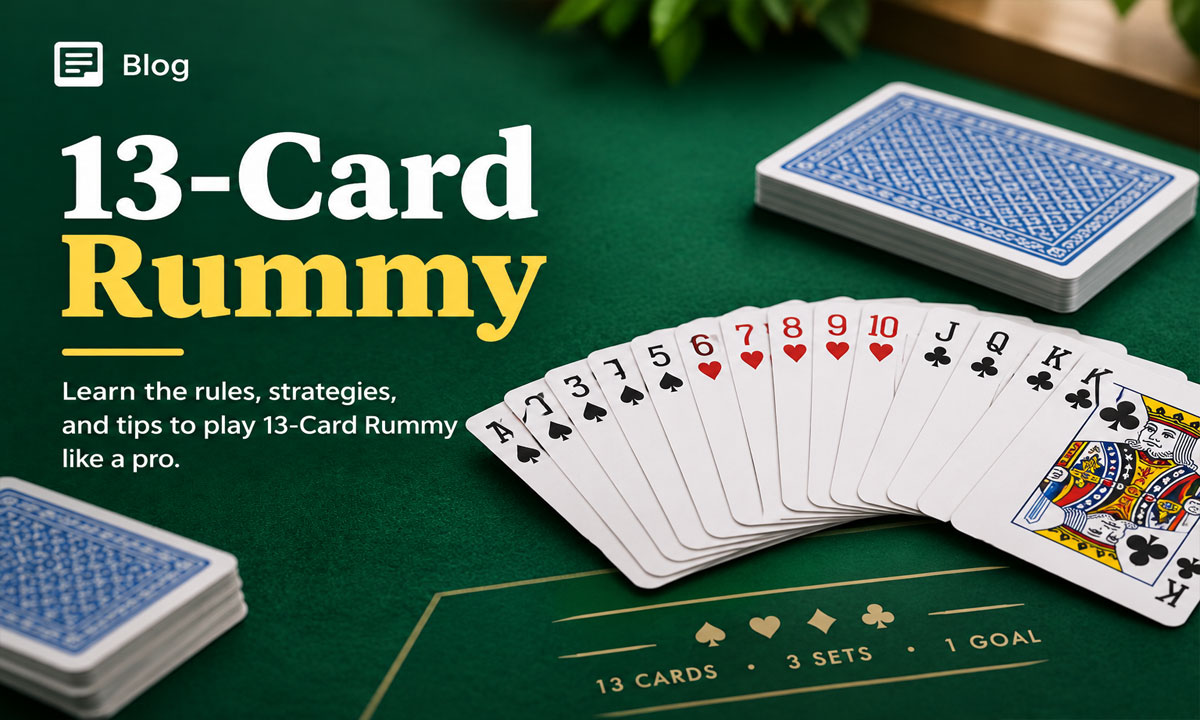
In this comprehensive guide, we will explore everything you need to know about set sizes in standard 13-card Rummy. We will discuss the role of jokers, contrast sets with sequences, and test your knowledge with practical examples. Let us dive in and clear up this common confusion once and for all.
What is a Set in Rummy? A Quick Refresher
Before we explore the size limits, we must clearly define what a set actually is. In standard 13-card Rummy, players aim to arrange their hands into organized groups known as melds.
A set is one of the two main types of melds you can create. It focuses entirely on the rank, or face value, of the cards.
To form a valid set, you must group cards of the exact same rank together. However, the most critical rule is that every single card in that group must belong to a different suit. You can never have two cards of the same suit in a valid set.
Why 4 is the Absolute Maximum Limit
So, can a set have more than 4 cards in Rummy? The answer is mathematically tied to the physical deck of cards. A standard French-suited deck contains exactly four suits: Hearts, Diamonds, Clubs, and Spades.
Because a valid set strictly requires unique suits, you can only ever collect one card from each suit. Therefore, the absolute maximum limit for a natural set is exactly four cards.
Even though 13-card Rummy uses two combined decks (meaning there are two 8s of Hearts in play), you are forbidden from using both in a set. Duplicate suits are illegal in a set, firmly capping the size at four.
The Minimum Size of a Set Explained
While the maximum limit is four, you must also be aware of the minimum limit. To form a valid set, you need at least three cards.
If you hold a Jack of Hearts (J♥) and a Jack of Spades (J♠), this is just a pair. A pair has absolutely zero scoring value in 13-card Rummy.
You must find a third Jack of a different suit (like J♦ or J♣) to turn that useless pair into a valid, points-saving set.
Can a Set Have Exactly 4 Cards? Yes!
Forming a 4-card set is a fantastic way to quickly group your leftover cards. Let us look at how real players execute this at the table.
Imagine Rahul is holding the 5 of Hearts (5♥), 5 of Spades (5♠), and 5 of Diamonds (5♦). He draws the 5 of Clubs (5♣) from the closed deck.
Rahul can legally group all four of these cards together. Because all four suits are unique and the ranks match perfectly, he has successfully created a maximum-sized 4-card set.
What Happens if You Try to Add a 5th Card?
Beginners often get excited when they draw another matching number. For instance, what if Ahmed already has a valid 4-card set of 8s (8♥ 8♠ 8♦ 8♣), and he draws another 8 of Hearts?
If Ahmed adds that second 8 of Hearts to his group, he has created an invalid 5-card group.
Why? Because his group now contains two cards of the exact same suit (Hearts). In traditional Rummy rules, duplicate suits instantly invalidate the entire set, exposing him to penalty points.
[Image Alt Text: A player holding a fan of Rummy cards, showing a valid 4-card set next to a separate sequence.]
Do Joker Variants Allow More Than 4 Cards?
This is where things can get slightly tricky. You might wonder if adding a wild joker or a printed joker allows you to break the 4-card limit.
In strict, traditional Indian Rummy, the answer is still no. A set is generally capped at four cards, representing the four unique suits. If you have four natural cards of different suits, you cannot add a joker to make a 5-card set.
However, it is worth noting that some highly casual house rules or specific digital apps might allow a 5-card set if it contains four unique suits plus a joker. Despite this rare exception, you should always assume the maximum limit is four when playing competitively.
The Role of Jokers in a 4-Card Set
Jokers are incredibly powerful tools that carry zero penalty points. You can absolutely use them to complete a standard 3-card or 4-card set.
When you place a joker into a set, it automatically assumes the identity of any missing suit required to make the group valid.
For example, if Priya has a King of Spades and a King of Clubs, she can add a joker. The game treats that joker as either the King of Hearts or the King of Diamonds.
Can a Set Contain 3 Real Cards + 1 Joker?
Yes, this is a perfectly valid and common strategy. If you have three natural cards of unique suits, you can use a joker to act as the fourth suit.
Imagine Fatima holds the 7 of Hearts, 7 of Diamonds, and 7 of Clubs. She wants to make a 4-card set but cannot find the 7 of Spades.
She can legally add a printed joker to the group. The final meld (7♥ 7♦ 7♣ + Joker) is a fully valid 4-card set.
Can a Set Contain 2 Real Cards + 2 Jokers?
Most standard online platforms and traditional rules heavily support the use of multiple jokers. Therefore, you can use two real cards and two jokers to form a 4-card set.
For example, 10♠ + 10♥ + Wild Joker + Printed Joker is entirely valid.
However, you cannot form a set consisting entirely of jokers. You must always have at least one natural card to anchor the rank of the set.
Set vs. Sequence: Why Sequences CAN Go Beyond 4 Cards
A common source of beginner confusion is mixing up the rules for sets with the rules for sequences.
A sequence is a run of consecutive cards that share the exact same suit (for example, 4♠ 5♠ 6♠).
Unlike sets, sequences are not limited by the four suits. Because a sequence climbs numerically within a single suit, it can theoretically contain all 13 cards of that suit. Therefore, while sets are strictly capped at four cards, sequences can easily go beyond four.
Comparison Table: Set vs. Sequence Size Limits
To keep these rules crystal clear, here is a quick comparison table contrasting the limits of both combinations.
| Feature | Valid Set | Valid Sequence |
| Core Rule | Same rank, different suits. | Consecutive ranks, same suit. |
| Minimum Cards | 3 Cards | 3 Cards |
| Maximum Cards | 4 Cards (natural) | Up to 13 Cards |
| Duplicate Suits | Strictly Forbidden. | Mandatory (Must be one suit). |
| Example of Maximum | 9♥ 9♠ 9♦ 9♣ | A♠ 2♠ 3♠ 4♠ 5♠ 6♠ 7♠… |
Common Myths About Set Size in Rummy
Under the pressure of a ticking timer, players often fall for a few pervasive myths.
Myth 1: A 5-card natural set is possible.
This is mathematically impossible. With only four suits in a standard deck, a 5-card natural set would guarantee a duplicate suit, making it invalid.
Myth 2: Sets are mandatory to win.
This is entirely false. You can win a game of 13-card Rummy by forming only sequences. Sets are completely optional groupings.
How Set Size Affects Your 13-Card Strategy
Managing your set sizes is a vital part of your overall declaration strategy. You must group your 13 cards efficiently.
The most mathematically optimal way to divide 13 cards is into three groups of three, and one group of four (3+3+3+4 = 13).
Therefore, creating one valid 4-card set is an excellent way to cleanly group your cards. Just remember not to force a fifth card into that set, as it will ruin your entire declaration.
Platform-Specific Rules in India and Pakistan
When playing on digital Rummy platforms popular in South Asia, the computer algorithms strictly enforce the rules.
If you try to declare a hand with a 5-card natural set, the app will instantly flag it as an invalid declaration.
This strict enforcement results in an automatic 80-point penalty for the player. Therefore, trusting the 4-card maximum rule is essential for preserving your bankroll online.
Practice Examples: “Is This Set Valid?”
Let us test your knowledge. Read the following groups and decide if they are valid or invalid based on the maximum size rules.
Example 1: 4♥ 4♠ 4♦ 4♣.
Verdict: Valid. This is a perfect, maximum-sized 4-card set with unique suits.
Example 2: Q♥ Q♠ Q♦ Q♣ Q♥.
Verdict: Invalid. This contains five cards and duplicates the Queen of Hearts.
Example 3: 8♣ 8♠ Wild Joker Printed Joker.
Verdict: Valid. It contains a maximum of four cards, anchored by unique natural cards, with jokers filling the missing suits.
Frequently Asked Questions (FAQ)
1. Can a set have more than 4 cards in Rummy?
No. Because a standard deck only has four unique suits, a valid natural set can never exceed four cards. Adding a fifth card duplicates a suit, which makes the set invalid.
2. Can I use two Jokers to make a 4-card set?
Yes. You can use two natural cards of different suits alongside two jokers to create a valid 4-card set.
3. What is the minimum number of cards required for a set?
You need an absolute minimum of three cards. Grouping just two matching cards is only a pair and carries no scoring value.
4. Why can a sequence have more than 4 cards but a set cannot?
A sequence relies on numerical order within a single suit, meaning it can stretch up to 13 cards. A set relies on matching ranks across different suits, capping it at the deck’s maximum of four suits.
5. Does an invalid set ruin my whole hand?
Yes. If you declare your hand and even one of your sets contains duplicate suits (or too many cards), your entire declaration is invalid, resulting in maximum penalty points.
6. Can I declare my hand without making any sets?
Absolutely. Sets are optional. As long as you meet the minimum 2-sequence rule (with at least one pure sequence), your remaining cards can be grouped into more sequences instead of sets.
Conclusion
Understanding the limits of your cards is what separates amateurs from experts. So, can a set have more than 4 cards in Rummy? By now, you know the definitive answer is no.
Because standard Rummy rules strictly prohibit duplicate suits within a set, you are mathematically capped by the four suits available in the deck. While sequences can stretch out into massive runs, sets must remain tight, concise groups of three or four cards.
By remembering this golden rule, sorting your cards properly, and utilizing your jokers wisely, you will avoid the most devastating beginner mistakes. Keep your sets to a maximum of four, prioritize your pure sequence, and enjoy mastering the beautiful game of Rummy!