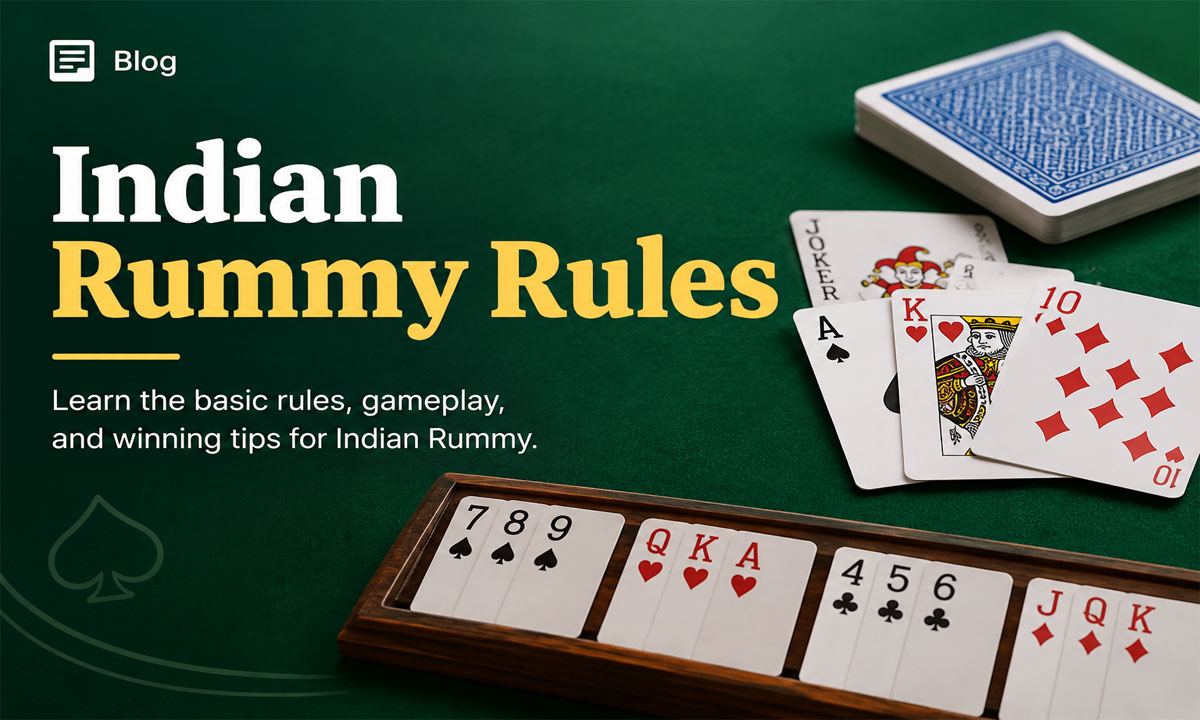
Card games have always held a special place in South Asian households. Whether it is a festive Diwali night in India or a relaxed winter evening with cousins in Pakistan, a deck of cards brings people together. If you have always wanted to join the fun but felt intimidated, you are in the perfect place. Learning the 13 Card Rummy Rules for Beginners is much easier than it looks from the outside.
This comprehensive guide is designed specifically for new players. We will walk you through everything from the basic setup to advanced winning strategies. By the end of this article, you will confidently sit at any table and know exactly how to play.
13-card rummy is a thrilling, skill-based card matching game. The core mechanic relies on drawing cards from a pile and discarding the ones you do not need. It is the most popular rummy format played across both India and Pakistan today.
Unlike games of pure luck, 13-card rummy heavily rewards strategy, memory, and careful observation. Therefore, an experienced player can often turn a seemingly bad starting hand into a brilliant victory. This blend of skill and chance is exactly why the game is so deeply loved.
Historically, rummy variants evolved over centuries before reaching South Asia. Once here, the 13-card version perfectly resonated with the local culture. It allowed enough complexity for competitive adults while remaining simple enough for teenagers to learn quickly.
13-card rummy is a draw-and-discard game requiring strategy and skill.
It is incredibly popular across India and Pakistan for festivals and family gatherings.
The game balances memory and tactics, rewarding smart decision-making over pure luck.
13-Card Rummy vs. Other Rummy Variants
If you are exploring the world of card games, you might hear about other formats. The most common alternatives are 21-card rummy and 7-card rummy (often called Gin Rummy). However, the 13-card version remains the undisputed favorite.
The 7-card version is usually played by just two players and is very fast-paced. On the other hand, the 21-card variant is highly complex, requires three decks, and is mostly played during major festivals. The 13-card format hits the perfect sweet spot between speed and strategic depth.
Comparison Table: 13-Card vs 21-Card Rummy
Feature
13-Card Rummy
21-Card Rummy
Cards Dealt
13 per player
21 per player
Decks Used
2 standard decks
3 standard decks
Mandatory Sequences
2 minimum (1 must be pure)
3 pure sequences minimum
Game Pace
Fast to Moderate
Very Slow and Complex
Best For
Beginners & Everyday Play
Advanced Players & Festivals
Setting Up the Table
A standard game of 13-card rummy requires 2 to 6 players. Because every player receives 13 cards, a single deck is not enough for larger groups. Therefore, a standard game always uses two full decks of cards.
If you are playing digitally, the software handles the setup automatically. However, if you are playing physically with friends, sit in a comfortable circle. Ensure the center of the table is clear to accommodate the draw and discard piles.
The Deck and Card Point Values
This game uses standard 52-card French-suited decks. Additionally, the game utilizes jokers, which are incredibly powerful tools. There are two types of jokers you must know.
First is the printed joker, which comes standard in every physical card box. Second is the wild joker, which is selected entirely at random at the beginning of each specific round. We will explain exactly how to use these jokers shortly.
In this game, points are actually a bad thing. Your ultimate goal is to reduce your total points to zero. Therefore, you must understand exactly what each card is worth.
Jokers carry zero points and are your best friends in the game.
How to Deal the Cards
To start the game, players randomly select a dealer. The dealer takes the two combined decks and shuffles them thoroughly. Proper shuffling is vital to ensure cards from previous rounds are completely mixed.
Next, the dealer distributes exactly 13 cards to each player, moving in a clockwise direction. Once every player has their cards, they should pick them up and sort them by suit and color. Sorting prevents confusion during fast-paced play.
The remaining cards are placed face-down in the center of the table. This stack becomes the closed deck (also known as the draw pile).
Finally, the dealer pulls the top card from the closed deck and flips it face-up next to it. This single card creates the discard pile (also known as the open deck).
The Objective of the Game
The main objective of 13-card rummy is beautifully simple. You must arrange all 13 of the cards in your hand into valid groups. You must complete this task faster than anyone else at the table.
Once every single card is correctly grouped, you announce your victory to the table. This action brings the round to an end.
What is a Meld? Sets vs Sequences
To win, you must group your cards into valid combinations known as a meld. There are exactly two types of melds you can create: sets and sequences.
Understanding Sets
A set is a group of three or four cards that share the exact same rank but have completely different suits. You cannot duplicate a suit within a single set.
For example, if Rahul holds the 5 of Hearts (5♥), 5 of Spades (5♠), and 5 of Clubs (5♣), he has formed a valid set. However, if Fatima groups two 7s of Diamonds (7♦, 7♦) with a 7 of Spades (7♠), her set is totally invalid.
Understanding Sequences
A sequence is a run of three or more consecutive cards that belong to the exact same suit. Sequences are the most important melds in the game. For instance, the 9, 10, and Jack of Spades (9♠-10♠-J♠) form a valid sequence.
Pure Sequence vs Impure Sequence
Sequences are further divided into two critical categories. Understanding the difference is the most important part of learning 13 card rummy rules for beginners.
A pure sequence is a consecutive run of the same suit that uses absolutely no jokers. It consists entirely of natural cards. For example, 3♣-4♣-5♣ is a pure sequence.
An impure sequence, meanwhile, uses a joker to fill in a missing gap. Imagine Priya has the 8♥ and the 10♥. She can use a printed joker to act as the missing 9♥. Thus, 8♥-Joker-10♥ becomes a valid impure sequence.
The Mandatory 2-Sequence Rule
To win the game, you cannot just make sets. The rules state you must have a minimum of two valid sequences in your hand.
More importantly, out of those two sequences, at least one must be a pure sequence. If you arrange all your cards but fail to form a pure sequence, your hand is entirely invalid.
Quick Recap: Melds and Sequences
A set is 3-4 cards of the same rank but different suits.
A sequence is 3+ consecutive cards of the same suit.
You MUST have at least one pure sequence (no jokers) to win the game.
How Jokers Work in 13-Card Rummy
We briefly mentioned jokers earlier, but let us look closer at how they function. Jokers act as universal substitutes, helping you complete sets and impure sequences rapidly.
While the printed joker is easy to spot, the wild joker adds a fun twist. Right after dealing, the dealer pulls one random card from the closed deck and places it face-up underneath the pile.
If that pulled card is the 6 of Diamonds (6♦), then every single 6 in the deck (6♠, 6♥, 6♣) magically becomes a wild joker for that specific round.
How a Turn Works
Gameplay moves in a clockwise circle, starting with the player to the dealer’s left. A standard turn consists of three distinct actions.
First, you must draw a card. You can either blindly pick the top card from the closed deck, or you can take the visible top card from the discard pile.
Next, you evaluate your hand. You now temporarily hold 14 cards. Look for ways to improve your melds and identify your most useless card.
Finally, you must discard one card face-up onto the discard pile. This brings your hand back down to 13 cards. Your turn is now over, and the next player repeats the process.
How to Declare (Show) Your Hand
When you finally group all 13 of your cards into valid melds, it is time to win. During your turn, instead of discarding your 14th card normally, you place it face-down and announce “Show” or “declare“.
After declaring, you must immediately lay all your cards face-up on the table for everyone to inspect. Your opponents will verify that you meet the mandatory sequence requirements.
Valid vs Invalid Declarations
A valid declaration occurs when your hand strictly follows all rules. For example, Ahmed shows one pure sequence, one impure sequence, and two valid sets. He wins with zero points.
An invalid declaration happens when you make a mistake. If Vikram declares but accidentally has a set with duplicate suits, his declaration is invalid. This instantly penalizes him with maximum points.
Scoring System and Penalties
When a player makes a valid declaration, the losing players must calculate their penalty points. You only count the points of cards that are not part of a valid meld.
If Ayesha loses a round, and she has an ungrouped King (10 points) and a 4 (4 points), her penalty is 14 points.
However, if a losing player fails to form a pure sequence, their entire hand of 13 cards is counted as penalty points, even if they formed sets. To prevent massive, game-ending losses, the maximum penalty a player can take in a single round is capped at 80 points.
Quick Recap: Gameplay and Scoring
Every turn requires you to draw one card and discard one card.
To win, declare your hand by grouping all 13 cards correctly.
Losing players take penalty points for their ungrouped cards, capped at 80 points.
Common Beginner Mistakes in 13-Card Rummy
When learning how to play, beginners often fall into a few predictable traps. Fixing these errors will instantly improve your gameplay.
First, beginners often ignore the pure sequence and try to build sets first. This is a fatal mistake. Always prioritize your pure sequence, because without it, your entire hand is counted as a penalty.
Second, new players tend to hoard high-value cards like Kings and Aces, hoping to eventually form a sequence. If an opponent declares early, you will be stuck with massive penalty points. Discard unmatched high cards quickly.
Finally, beginners often forget to watch the discard pile. If you are not paying attention to what your opponents are picking up, you might accidentally discard the exact card they need to win.
Top 10 Beginner Tips and Strategies
Sort by Colors: Alternate your cards Red-Black-Red-Black. This prevents you from accidentally throwing away a needed card.
Focus on the Pure Sequence: Make this your absolute first priority the moment you pick up your cards.
Use Middle Cards: Cards like 5, 6, and 7 are highly versatile because they can form sequences in both directions.
Do Not Hoard Jokers: Jokers carry zero points, but they are only useful if they complete a meld. Use them aggressively.
Watch Opponents: Keep a sharp eye on what the player next to you is drawing from the discard pile.
Discard High Cards Early: Get rid of unmatched Aces, Kings, Queens, and Jacks to lower your potential penalty points.
Know When to Drop: If your starting hand is terrible, you can choose to “drop” before playing for a minor 20-point penalty, rather than risking an 80-point loss.
Bluffing: Sometimes, discarding a card close to what you need can trick your opponent into throwing the exact card you want.
Double-Check Sets: Always verify that your sets do not contain duplicate suits before you declare.
Practice Patience: Rummy is a game of skill. Do not get frustrated by early losses; use them to learn.
Popular 13-Card Rummy Variants
While the core rules remain identical, South Asians love variety. There are three main formats you will encounter in clubs or on apps.
Points Rummy is the fastest version. It lasts for only one single deal. Players agree on a monetary value per point, and the winner collects the pot immediately.
Pool Rummy is an endurance format. Players are eliminated once their total penalty points reach a specific limit, usually 101 or 201 points.
Deals Rummy requires players to compete over a fixed number of rounds (such as 2, 3, or 6 deals). At the end of all the deals, the player with the most chips is declared the winner.
A Note on Responsible Gaming
While 13-card rummy is a brilliant test of skill and memory, it is vital to approach the game responsibly. This is especially true if you transition to playing for real stakes online.
Players must be 18 years of age or older to participate in cash games. In India, the Supreme Court recognizes rummy as a game of skill, making it legal in most states. In Pakistan, the legal landscape is different, and players usually enjoy free-to-play platforms or friendly home games.
Always set strict budget and time limits before you begin playing. View the game as a form of entertainment, keep a clear head, and never chase your losses.
Quick Recap: Strategies and Variants
Discard high cards quickly and always watch your opponents’ moves.
Explore different variants like Points, Pool, and Deals rummy.
Always play responsibly, within your limits, and ensure you are of legal age.
Frequently Asked Questions (FAQ)
1. Can I make a pure sequence with more than three cards?
Yes, absolutely. A pure sequence can easily contain four, five, or even six consecutive cards of the same suit. Three is simply the minimum requirement.
2. Can an Ace be used as a low card and a high card?
Yes. You can use an Ace as a low card alongside a 2 and 3 (A-2-3). You can also use it as a high card with a King and Queen (Q-K-A). However, it cannot loop around (K-A-2 is invalid).
3. What happens if the closed deck runs out of cards?
If the draw pile is completely exhausted before anyone wins, the dealer simply takes the discard pile, shuffles it thoroughly, and turns it face-down to create a brand new closed deck.
4. Can I pick a discarded Joker from the open deck?
Under standard rules, if an opponent actively discards a joker, you are not allowed to pick it up. You must draw from the closed deck instead.
5. How many jokers can I use in one meld?
You can use multiple jokers in an impure sequence or a set. However, a meld cannot consist entirely of jokers.
6. Do I lose points if I drop out of the game?
Yes, but it is a strategic loss. Dropping before you pick your first card costs 20 points. Dropping later in the game (a middle drop) costs 40 points.
7. Why is 13-card rummy considered a game of skill?
Because you must actively calculate probabilities, memorize discarded cards, and strategize your melds. A skilled player will consistently beat an unskilled player over time, proving it relies on brainpower over pure luck.
Conclusion
Learning the 13 Card Rummy Rules for Beginners is your gateway to endless hours of strategic entertainment. While managing 13 cards and tracking different sequences might feel slightly overwhelming during your first few hands, it quickly becomes second nature.
Remember the golden rules: prioritize your pure sequence immediately, discard unmatched high-value cards early, and always keep a close eye on the discard pile. Do not be discouraged if you lose a few rounds while you are still learning the ropes.
Now that you understand the mechanics, the absolute best way to improve is simply to play. Gather your family, shuffle the decks, and deal the cards. With a little patience and practice, you will be confidently declaring your hands and winning rounds in no time!