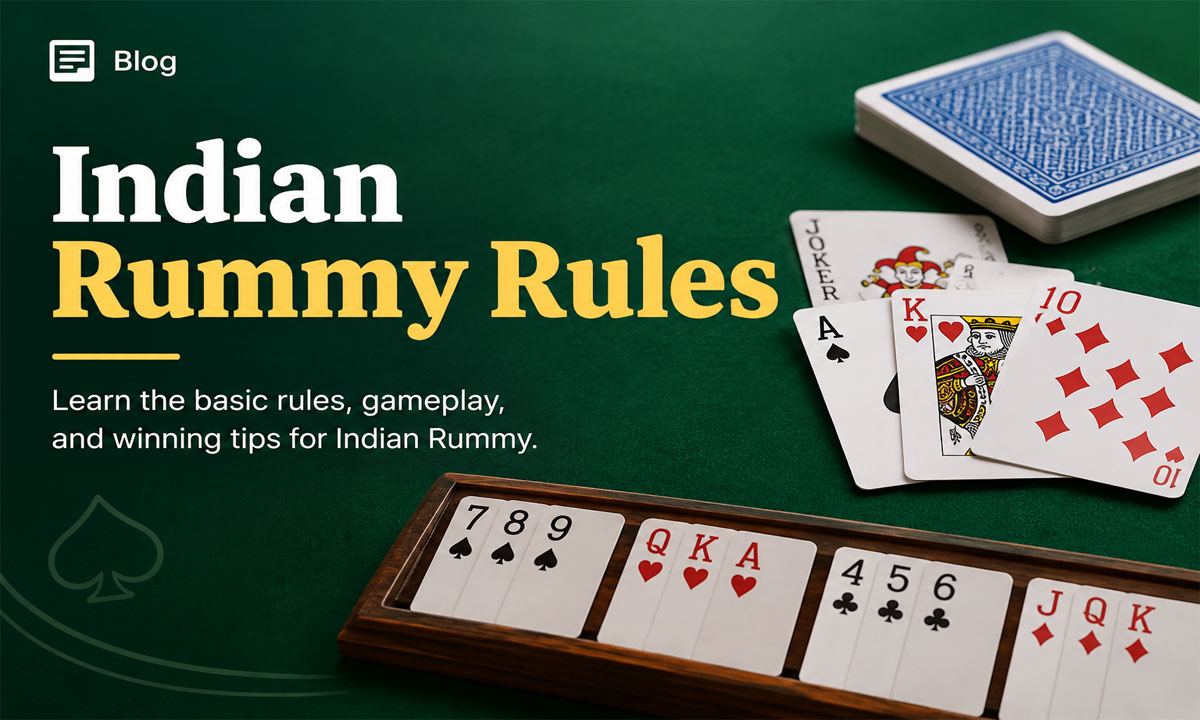
13-card Rummy stands as the undisputed king of card games across the Indian subcontinent, bringing families and friends together for hours of strategic entertainment. Having the 13 card rummy rules explained properly is your first step toward transforming from a hesitant beginner into a confident, winning player.
Unlike games of pure chance, this format demands sharp memory, quick calculations, and a keen eye for your opponents’ moves. Once you grasp the foundational mechanics, you will quickly discover why millions of players prefer this specific variation over any other.

This guide will break down every single aspect of the game, from the initial deal to the final declaration. Whether you are playing for bragging rights during a family gathering or competing on popular rummy apps in India and Pakistan, this comprehensive breakdown has you covered.
What is 13-Card Rummy and Its Cultural Roots?
13-card Rummy is a classic draw-and-discard matching game where players race to group their cards into valid combinations. It is widely considered a game of skill, heavily rewarding players who practice and refine their strategies.
Across India and Pakistan, this game is deeply woven into the cultural fabric. It is the centerpiece of festive celebrations like Diwali, a staple of long train journeys, and a weekend tradition in local clubs.
Over the years, it has seamlessly transitioned from physical tables to digital platforms. Today, players from Karachi to Mumbai log onto mobile apps to test their skills in fast-paced digital tournaments.
The Core Setup: Players and Decks
A standard game accommodates anywhere from two to six players at a single table. The number of players directly influences the pace of the game and how quickly the discard pile cycles.
When playing head-to-head with just two players, the game moves incredibly fast. Conversely, a full six-player table requires more patience and deeper observation of multiple opponents.
To support 13 cards per person, standard games utilize two full 52-card decks. This ensures there are plenty of cards remaining for the draw pile after the initial deal is complete.
Understanding the Deck: Printed Jokers and Wild Jokers
Jokers are the most powerful cards in your hand, acting as universal substitutes to help you complete combinations. There are two distinct types of jokers you must understand.
The Printed Joker is the traditional joker card that comes packaged with any standard deck of cards. Typically, two to four printed jokers are included in a standard two-deck rummy setup.
The Wild Joker is a card chosen entirely at random at the beginning of each round. If the dealer flips a 7 of Hearts (7♥) as the wild joker, then every single 7 in the deck (7♠, 7♣, 7♦) instantly becomes a wild joker for that game.
- 13 Card Rummy Rules for Beginners
- The Objective of 13 Card Rummy Explained
- 13 Card Rummy vs 21 Card Rummy Rules
Card Point Values
In 13-card rummy, points are generally a bad thing. Your ultimate goal is to reach zero points by grouping all your cards. If an opponent wins the game, you are penalized based on the ungrouped cards remaining in your hand.
Here is exactly how the cards are valued:
| Card Type | Specific Cards | Point Value |
| Face Cards & Aces | Ace (A), King (K), Queen (Q), Jack (J) | 10 Points Each |
| Numbered Cards | 2, 3, 4, 5, 6, 7, 8, 9, 10 | Face Value (e.g., 6 = 6 points) |
| Jokers | Printed Jokers, Wild Jokers | 0 Points |
The Main Objective of the Game
Your primary goal is to organize all 13 cards in your hand into specific, valid groupings known as melds. You must complete this task faster than anyone else at the table.
Once every single card is correctly grouped according to the rules, you can end the game by making a valid declaration. The first player to successfully declare their hand wins the round with zero penalty points.
How the Cards Are Dealt
Every round begins with the dealer shuffling the two combined decks thoroughly. They then distribute exactly 13 cards to each player, dealing one at a time in a clockwise direction.
After the deal, the dealer places the remaining stack of cards face-down in the center of the table. This stack becomes the Closed Deck (or draw pile).
Finally, the dealer takes the top card from the Closed Deck and flips it face-up to start the Discard Pile (or open deck). The game is now ready to begin.
What is a Meld? Sets and Sequences Explained
A meld is simply a collection of cards that form a valid combination under rummy rules. To win, every card in your hand must be part of a meld. There are only two types of melds you can create: Sets and Sequences.
Valid Sets
A set is a group of three or four cards of the exact same rank, but completely different suits. You cannot duplicate a suit within a single set.
For example, if Rahul groups the 8♠, 8♥, and 8♦, he has created a perfectly valid set. However, if he groups two 8♠ with an 8♥, the set is completely invalid. Jokers can also be used to complete a set, such as grouping a 9♣, 9♦, and a Printed Joker.
Valid Sequences: Pure vs. Impure
A sequence is a run of three or more consecutive cards belonging to the exact same suit. Sequences are divided into two critical categories.
A Pure Sequence contains only natural cards of the same suit, with absolutely no jokers involved. For instance, the 4♣, 5♣, and 6♣ form a pure sequence.
An Impure Sequence is a consecutive run of the same suit that uses a joker to fill a missing gap. If Priya has the 10♥ and the Queen (Q♥), she can use a Wild Joker to act as the missing Jack (J♥).
Melds Quick Reference Guide
| Meld Type | Example | Valid or Invalid? | Reason |
| Set | 5♠, 5♥, 5♣ | Valid | Same rank, three different suits. |
| Set | K♦, K♦, K♠ | Invalid | Duplicate suit (two Diamonds). |
| Pure Sequence | 9♠, 10♠, J♠, Q♠ | Valid | Consecutive order, same suit, no jokers. |
| Impure Sequence | 2♥, 3♥, Wild Joker, 5♥ | Valid | Joker substitutes for the missing 4♥. |
| Invalid Sequence | 7♣, 8♣, 9♠ | Invalid | The 9 is a Spade, breaking the suit requirement. |
The Golden Rule of 13-Card Rummy
If you remember nothing else from this guide, remember this: you cannot declare your hand without meeting the minimum sequence requirements.
“To make a valid declaration in 13-card rummy, you must have at least two sequences. Out of these two, at least one must be a pure sequence.”
If you arrange all your cards but fail to include a pure sequence, your declaration is illegal. The remaining cards can be arranged as additional sequences or sets, but that first pure sequence is your lifeline.
13 Card Rummy Rules Explained: How a Turn Works
Gameplay moves clockwise, starting with the player seated to the dealer’s left. A standard turn consists of three distinct phases: the draw, the evaluation, and the discard.
First, you must draw one card to begin your turn. You can blindly draw the top card from the face-down Closed Deck, or you can pick up the visible top card from the face-up Discard Pile.
Once you draw, you will briefly hold 14 cards. You must evaluate your hand, fit the new card into your strategy, and select your most useless card.
Finally, you must discard one card face-up onto the Discard Pile. Your turn officially ends, leaving you back at 13 cards, and the next player takes their turn.
Rules for Picking from the Discard Pile
The discard pile offers great opportunities, but it comes with restrictions. You are only allowed to pick up the very top card of the discard pile. You cannot dig underneath to retrieve a card discarded earlier.
Additionally, if the player before you discards a Joker (either printed or wild), you are generally not allowed to pick it up. You must draw from the closed deck instead.
How to Declare Your Hand Successfully
When you have successfully arranged all 13 of your cards into valid melds (including your mandatory pure sequence), it is time to win the round.
During your turn, instead of discarding your 14th card onto the regular discard pile, you place it face-down (or into a designated ‘Finish’ slot online) and declare your hand to the table.
You must then lay your cards open for all opponents to verify. Ahmed, for example, shows his pure sequence, his impure sequence, and two valid sets. The table confirms his melds, and Ahmed wins the round with zero points.
Valid vs. Invalid Declarations
A valid declaration happens when your hand strictly follows the golden rule and contains zero unmatched cards.
An invalid declaration happens when you declare prematurely. For instance, if Zara declares but accidentally has a set with duplicate suits (like two 6♠), her declaration is illegal.
Making an invalid declaration is the worst mistake in the game. It instantly ends the round, hands the victory to your opponents, and penalizes you with the maximum possible points.
The Scoring System and the 80-Point Penalty
When a player wins, the losers must tally up their penalty points based on their unmatched cards. Face cards are worth 10, number cards are face value, and jokers are zero.
If Vikram loses but he successfully formed his mandatory pure sequence, he only counts the points of his completely ungrouped cards.
However, if Ayesha loses and she failed to form a pure sequence, all 13 of her cards are counted as penalties, regardless of whether she formed sets. To prevent devastating losses, the maximum penalty any player can take in a single round is capped at 80 points.
Common Beginner Mistakes to Avoid
Beginners often fall into predictable traps. Recognizing these early will instantly elevate your game.
First, do not hoard high-value cards like Kings and Aces while waiting for a sequence. If an opponent declares early, you will be stuck with a massive penalty. Discard unmatched high cards quickly.
Second, never ignore your opponents’ discards. If Rohan is picking up every Spade you throw, he is clearly building a Spade sequence. Stop feeding him the cards he needs.
Third, do not hold onto Jokers waiting for the “perfect” meld. Jokers carry zero points, so use them aggressively to close out impure sequences and sets as fast as possible.
Top Beginner Strategies to Win More Often
Sorting your cards efficiently is your best defense against mistakes. Group your cards by alternating colors (Red-Black-Red-Black). This visual separation stops you from accidentally discarding a card you need.
Focus heavily on middle cards. A 5, 6, or 7 is statistically more versatile than an Ace or a King because it can connect in both directions to form a sequence.
Finally, know when to drop out. If you are dealt a terrible hand with no jokers and no connecting cards, use the “Drop” option. Taking a 20-point penalty for an initial drop is far smarter than stubbornly playing a losing hand and taking an 80-point penalty.
Popular 13-Card Rummy Variants in India and Pakistan
While the core rules remain identical, the structure of the game changes across different variants.
Points Rummy is the fastest format, lasting only a single deal. Players pre-decide a monetary value per point (e.g., ₹1 or 5 PKR per point), and the winner takes the pot based on the opponents’ total penalty points.
Pool Rummy is an endurance format, usually played as 101 Pool or 201 Pool. Players are eliminated once their accumulated penalty points reach the 101 or 201 limit. The last player remaining at the table wins.
Deals Rummy requires players to compete over a fixed number of rounds (like 2, 3, or 6 deals). Everyone starts with a set amount of chips, and the player holding the most chips after the final deal wins.
Quick Comparison: 13-Card vs. 21-Card Rummy
While 13-card is the everyday standard, 21-card rummy is often played during major festivals.
In the 13-card game, you manage a smaller hand, requiring faster decisions and prioritizing a single pure sequence. It is played with two decks.
In the 21-card variant, players are dealt a massive hand, requiring three full decks. The rules demand at least three pure sequences, and it introduces complex “value cards” that alter the scoring system entirely. For beginners, stick to the 13-card format before attempting the 21-card beast.
Responsible Gaming and Legal Awareness
Rummy is a brilliant test of skill, probability, and mental agility. However, it is vital to approach the game responsibly, especially when playing for stakes.
Players should always be 18 years of age or older. Set strict time limits for your sessions and never gamble money you cannot afford to lose.
Legal landscapes vary across South Asia. In India, the Supreme Court has declared rummy a game of skill, making it legal in most states, though specific state laws apply. In Pakistan, the game is widely enjoyed socially, but playing online for real money falls into complex legal gray areas. Always respect your local digital gaming laws.
Frequently Asked Questions (FAQ)
1. Can an Ace be used as a low and high card?
Yes. You can use an Ace as a low card (A-2-3) or as a high card (Q-K-A). However, you cannot loop the sequence (e.g., K-A-2 is strictly invalid).
2. Can I use multiple jokers in a single meld?
Absolutely. You can use two or even three jokers to complete an impure sequence or a set. Just ensure you still have your mandatory pure sequence elsewhere.
3. What happens if the closed deck runs out of cards?
If the draw pile is completely depleted before anyone declares, the dealer simply takes the discard pile, shuffles it thoroughly, and turns it face-down to create a new closed deck.
4. Can a pure sequence have more than three cards?
Yes. A pure sequence can easily contain four, five, or even six consecutive cards of the same suit. Three is simply the minimum requirement.
5. Do I lose points if I drop out of the game?
Yes, but it is a calculated loss. An initial drop (before picking your first card) costs 20 points. A middle drop (dropping later in the game) costs 40 points.
6. Can I pick a discarded Joker from the open deck?
Under standard rules, if an opponent actively discards a joker, the next player is not allowed to pick it up. You are forced to draw from the closed deck on that turn.
Your Next Steps at the Rummy Table
Having the 13 card rummy rules explained in detail is only half the battle. The true mastery of this game comes from sitting at the table, shuffling the deck, and testing your strategic mind against real opponents.
Do not feel discouraged if you lose your first few hands. Focus on building that pure sequence as quickly as possible, watch the discard pile like a hawk, and do not let unmatched high cards ruin your score.
Whether you are playing a friendly match with cousins or joining an online beginner’s table, you now have the expert knowledge required to play with confidence. Deal the cards, arrange your melds, and enjoy the timeless thrill of 13-card rummy.