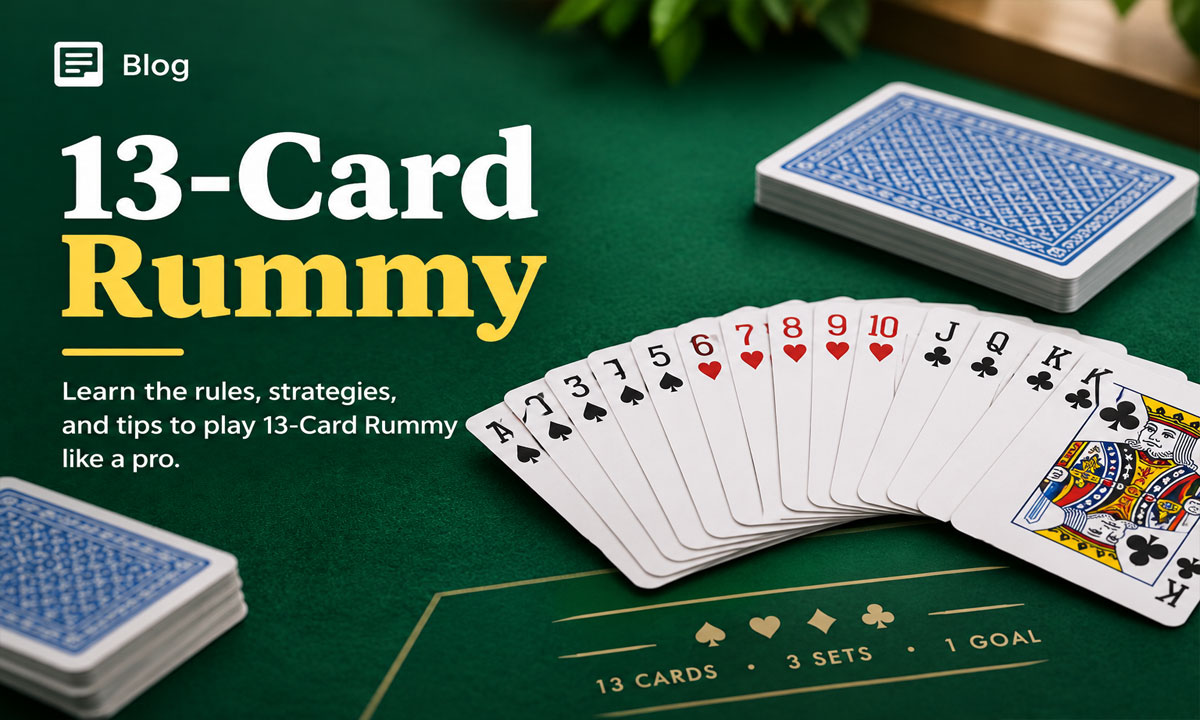
Card games have always been the lifeblood of family gatherings and festive nights across South Asia. Whether it is Diwali in India or a cozy winter evening in Pakistan, a deck of cards brings people together.
If you are looking to dominate your next game night, you have come to the right place. This Ultimate Guide to Indian Rummy Rules will teach you everything from basic setup to advanced winning strategies.
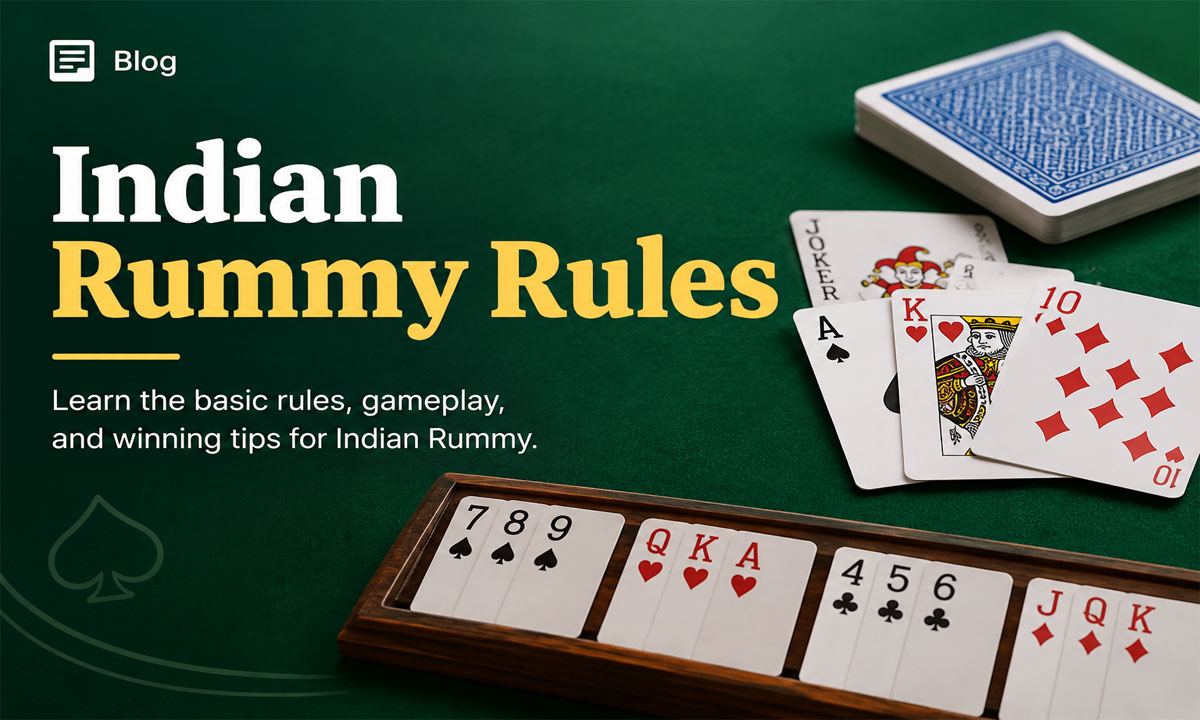
Learning how to play Indian Rummy might seem intimidating at first glance. However, once you understand the core mechanics, it becomes a fascinating game of skill, memory, and strategy.
By the end of this guide, you will know exactly how to form sequences, use jokers, and declare your hand like a seasoned pro. Let’s dive into the fascinating world of 13-card rummy.
What is Indian Rummy?
Indian Rummy, frequently referred to as “Paplu” in certain regions, is a matching card game based on drawing and discarding cards. It is an extension of the classic rummy game but tailored specifically for South Asian preferences.
Unlike games of pure luck, Indian Rummy requires intense focus and analytical skills. Therefore, players must constantly monitor their opponents’ moves while calculating their own odds.
Culturally, this game holds massive significance in India and Pakistan. It is not just a game; it is a tradition passed down through generations. Today, it has successfully transitioned into the digital realm, boasting millions of online players.
[internal link: history of traditional card games in South Asia]
Key Terminology
Before you start playing, you must understand the language of the game. Here are the most important terms you will encounter.
- Pure Sequence: A consecutive run of three or more cards of the same suit, without using a Joker.
- Impure Sequence: A run of three or more cards of the same suit, where a Joker substitutes for one of the missing cards.
- Set: A group of three or four cards of the same rank, but completely different suits.
- Joker: A wild card used to represent any other card to form an impure sequence or a set.
- Meld: The act of grouping your cards into valid sequences and sets.
- Declare (or Show): Finishing the game by revealing your 13 cards correctly grouped into valid melds.
- Drop: Choosing to leave a hand before or during the game to minimize your point loss.
Number of Players and Card Setup
Indian Rummy is typically played with 2 to 6 players at a single table. Consequently, the number of decks used depends on how many players are participating.
For a standard game involving 2 to 6 players, you will need two standard decks of 52 cards each. Furthermore, two printed Jokers are included in the mix.
At the beginning of the game, a dealer is chosen at random. The dealer then shuffles the decks and deals exactly 13 cards to each player, one by one.
The remaining cards are placed face-down in the center of the table to form the “Draw Pile.” Afterward, the top card is flipped face-up to create the “Discard Pile.”
Objective of the Game
The primary objective of Indian Rummy is to arrange all 13 cards in your hand into valid sequences and sets. You must do this faster than your opponents.
To win, you must make a valid declaration. According to standard Indian Rummy rules, a valid declaration requires at least two sequences.
Most importantly, out of these two mandatory sequences, at least one must be a pure sequence. Without a pure sequence, your declaration is invalid, and you will receive a heavy penalty.
Basic Rules of Indian Rummy
The gameplay loop of Indian Rummy is quite straightforward. Players take turns in a clockwise direction starting from the person sitting to the left of the dealer.
During your turn, you must draw one card. You can either pick the top face-down card from the Draw Pile or the top face-up card from the Discard Pile.
Once you have drawn a card, you must discard one card from your hand onto the Discard Pile. Therefore, you always end your turn with exactly 13 cards in your hand.
You continue this cycle of drawing and discarding to improve your hand. As you play, you must group your cards into valid melds.
When all 13 of your cards are arranged in valid sequences and sets, you discard your 14th card into the “Finish Slot” and declare your hand.
- How to Play Indian Rummy Step-by-Step
- Rummy Rules for Beginners
- How Many Cards Are Dealt in India Rummy?
Valid Declaration Rules
Making a valid declaration is the most critical part of learning this game. If you declare incorrectly, you automatically lose the game and take maximum points.
To make a valid declaration, you must fulfill three specific conditions. First, all 13 cards must be arranged in valid sequences and sets.
Second, you must have a minimum of two sequences. You cannot declare a hand using only sets.
Third, and most crucially, at least one of those sequences must be a pure sequence. As long as these conditions are met, the remaining cards can be arranged in any combination of valid sets or impure sequences.
Types of Sequences and Sets
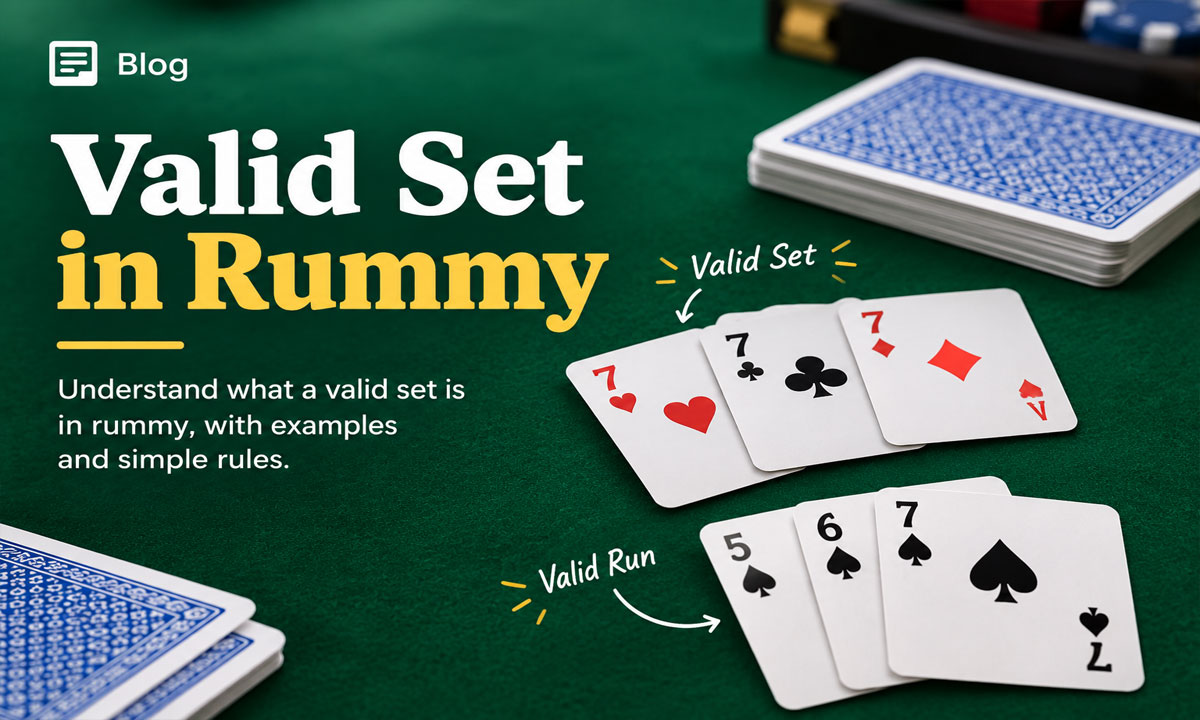
To truly grasp our Ultimate Guide to Indian Rummy Rules, you need to see exactly what valid melds look like. Let us look at some practical examples using card symbols.
Pure Sequence
A pure sequence uses no jokers.
- Valid Example: 5♥ 6♥ 7♥ 8♥
- Valid Example: 10♠ J♠ Q♠
Impure Sequence
An impure sequence uses a joker to fill a gap. Assuming the 2♦ is a wild joker:
- Valid Example: 4♣ 5♣ 2♦ 7♣ (The joker acts as the 6♣).
- Valid Example: 8♠ Printed Joker 10♠ (The joker acts as the 9♠).
Valid Sets
A set consists of the same rank but different suits.
- Valid Example: 9♥ 9♠ 9♣
- Valid Example: Q♦ Q♠ 2♦ (Where 2♦ is the joker acting as a Queen).
- Invalid Example: 7♥ 7♥ 7♠ (You cannot use two cards of the same suit in a set).
Joker Rules
Jokers play a massive role in Indian Rummy. They are the lifelines that help you complete your hand faster.
There are two types of jokers in the game. The first is the Printed Joker, which comes standard with every deck of cards.
The second is the Wild Joker. After the cards are dealt, the dealer pulls one random card from the draw pile and places it face-up under the deck.
This card, and all other cards of the same rank across all suits, become the Wild Jokers for that specific game. For example, if the 4♣ is pulled, then the 4♥, 4♦, and 4♠ all function as jokers.
However, remember that a joker cannot be used to form your mandatory pure sequence.
Points Calculation System
In Indian Rummy, points have a negative value. Therefore, the ultimate goal is to keep your score at zero. The winner of the hand always gets zero points.
When a player makes a valid declaration, the losing players must calculate the penalty points of their ungrouped cards.
- Face Cards (J, Q, K) and Aces: 10 points each.
- Numbered Cards (2-10): Face value (e.g., a 5 is worth 5 points).
- Jokers: 0 points.
If a losing player has not formed a pure sequence, all 13 cards are counted as penalty points. However, the maximum penalty a player can take in a single game is capped at 80 points.
If you feel your hand is terrible from the start, you can use the “Drop” option. An initial drop (before picking your first card) costs 20 points. A mid-drop (anytime after your first turn) costs 40 points.
Common Indian Rummy Variations
While the core rules remain the same, Indian Rummy has three highly popular variations. Knowing them will help you choose the format that best fits your play style.
Points Rummy
This is the fastest version of the game. Players play for a pre-decided monetary value per point. The game lasts for only one deal, making it incredibly fast-paced and thrilling.
Pool Rummy
Pool Rummy is an elimination-style game. It is usually played in two formats: 101 Pool and 201 Pool. Players are eliminated once their total score reaches 101 or 201 points, respectively, and the last player standing wins.
Deals Rummy
In Deals Rummy, players play a fixed number of deals (usually 2, 3, or 6). Everyone starts with a set amount of chips. At the end of the predefined deals, the player with the most chips is declared the winner.
[internal link: detailed guide to rummy variations]
Indian Rummy vs Other Rummy Variants
If you have played Western card games, you might wonder how Indian Rummy differs from Gin Rummy or Standard Rummy.
First, Indian Rummy uses 13 cards per player, whereas Gin Rummy usually uses 10. Consequently, Indian Rummy requires managing a larger hand and forming more melds.
Second, the point system differs. In Gin Rummy, you can “knock” with deadwood points, but in Indian Rummy, you must meld all 13 cards for a valid declaration.
Finally, the use of a randomly selected Wild Joker is highly specific to the Indian variation, adding an extra layer of unpredictability and excitement to the game.
Tips and Strategies for Beginners
Mastering this game takes time, but applying the right strategies can accelerate your progress. Here are some essential tips for beginners.
1. Focus on the Pure Sequence: Never delay forming your pure sequence. Since it is mandatory for a valid declaration, it should be your absolute first priority.
2. Discard High-Value Cards Early: Cards like Aces, Kings, Queens, and Jacks carry 10 penalty points each. If they are not fitting into a meld early on, discard them to lower your potential point burden.
3. Watch the Discard Pile: Always pay attention to what your opponents are picking up and throwing away. For instance, if your opponent picks up a 6♠, you should avoid discarding a 5♠ or 7♠.
4. Use Middle Cards Wisely: Cards like 5, 6, and 7 are highly versatile. A 6 can form a sequence with 4 and 5, or with 7 and 8. Hold onto them longer than high cards.
5. Know When to Drop: Ego has no place in Rummy. If your starting hand has no jokers and no pure sequence, it is strategically wiser to take a 20-point initial drop rather than risking an 80-point loss.
Common Mistakes to Avoid
Even seasoned players make mistakes. Recognizing these pitfalls early will save you a lot of points and frustration.
The most common mistake is declaring without a pure sequence. This oversight immediately results in an 80-point penalty and hands the win to your opponent. Always double-check your pure sequence before hitting the declare button.
Another frequent error is holding onto Jokers unnecessarily without using them. Jokers carry zero points, but they are only useful if they help complete a meld. Do not hoard them while ignoring your pure sequences.
Finally, many beginners forget to rearrange their cards. Grouping your cards by alternating colors (Red-Black-Red-Black) prevents accidental discards of cards you actually needed.
Indian Rummy Rules for Online Play
Playing Indian Rummy online has become a massive trend in India and Pakistan. While the rules are identical to the physical game, the digital environment introduces a few new dynamics.
Firstly, online platforms use Random Number Generators (RNG) to shuffle and deal cards. This ensures absolute fairness and prevents cheating or card counting.
Secondly, online Rummy is governed by strict time limits. You usually have 30 to 45 seconds to make your move. If you miss consecutive turns, the system will automatically drop you from the game.
Lastly, online platforms offer a “Sort” button. Pressing this button automatically arranges your cards into optimal groups by suit, which is incredibly helpful for beginners.
Legal Status in India and Pakistan
When playing for real money, players naturally have questions regarding legality. It is important to know the legal landscape in your respective region.
In India, the Supreme Court has declared Rummy a “game of skill” rather than a game of chance. Therefore, playing Indian Rummy for real money is perfectly legal in most Indian states, barring a few specific state-level exceptions.
In Pakistan, the legal landscape is slightly different. The game is wildly popular as a casual, home-based recreational activity. However, playing for real money online operates in a gray area, so players usually stick to free-to-play skill platforms or friendly wagers at home.
Disclaimer: Gambling laws change frequently. Always practice responsible gaming and verify the local laws in your specific state or province.
FAQs
1. Can I make a pure sequence with more than three cards? Yes, absolutely. A pure sequence can contain four, five, or even six cards, provided they are in consecutive order of the same suit.
2. Is it possible to use two jokers in a single meld? Yes, you can use multiple jokers in an impure sequence or a set. However, a meld cannot consist entirely of jokers.
3. What happens if the Draw Pile runs out of cards? If the Draw Pile is exhausted before anyone declares, the Discard Pile (except for the top card) is shuffled and placed face-down to form a new Draw Pile.
4. Can an Ace be used as a low and high card? Yes. In Indian Rummy, an Ace can form a sequence with 2 and 3 (A-2-3) or with a Queen and King (Q-K-A). However, it cannot loop (e.g., K-A-2 is invalid).
5. Do I lose points if I drop out of the game? Yes. An initial drop before playing any card costs 20 points. A middle drop during the game costs 40 points.
6. Can I use a Joker to make a pure sequence? No. By definition, a pure sequence cannot contain a joker. If a printed or wild joker is used, the sequence becomes impure.
Conclusion
Learning to play Indian Rummy opens the door to endless entertainment. It is a brilliant blend of mathematical probability, psychological observation, and strategic planning.
By applying the concepts outlined in this Ultimate Guide to Indian Rummy Rules, you are already steps ahead of the average beginner. Remember, your primary goal is to form that pure sequence as quickly as possible.
Take your time practicing with free games before moving to competitive tables. Observe experienced players, learn from your losses, and most importantly, remember to play responsibly.
Shuffle the deck, deal the cards, and may the best hand win!