










Card games are the beating heart of family gatherings, festive nights, and weekend hangouts across South Asia. Whether it is a Diwali party in India or a festive Eid evening in Pakistan, a deck of cards always brings people together. Among the countless games played, Indian Rummy stands out as the absolute favorite. It is a game that beautifully blends strategy, memory, and a little bit of luck.
If you have ever watched your uncles or friends intensely staring at their 13 cards and wondered what was going on, you are in the right place. Learning how to play Indian Rummy step-by-step might seem intimidating at first, but it is incredibly rewarding. Unlike simple games of chance, Indian Rummy is heavily skill-based. Consequently, a sharp mind will always beat a lucky hand in the long run.
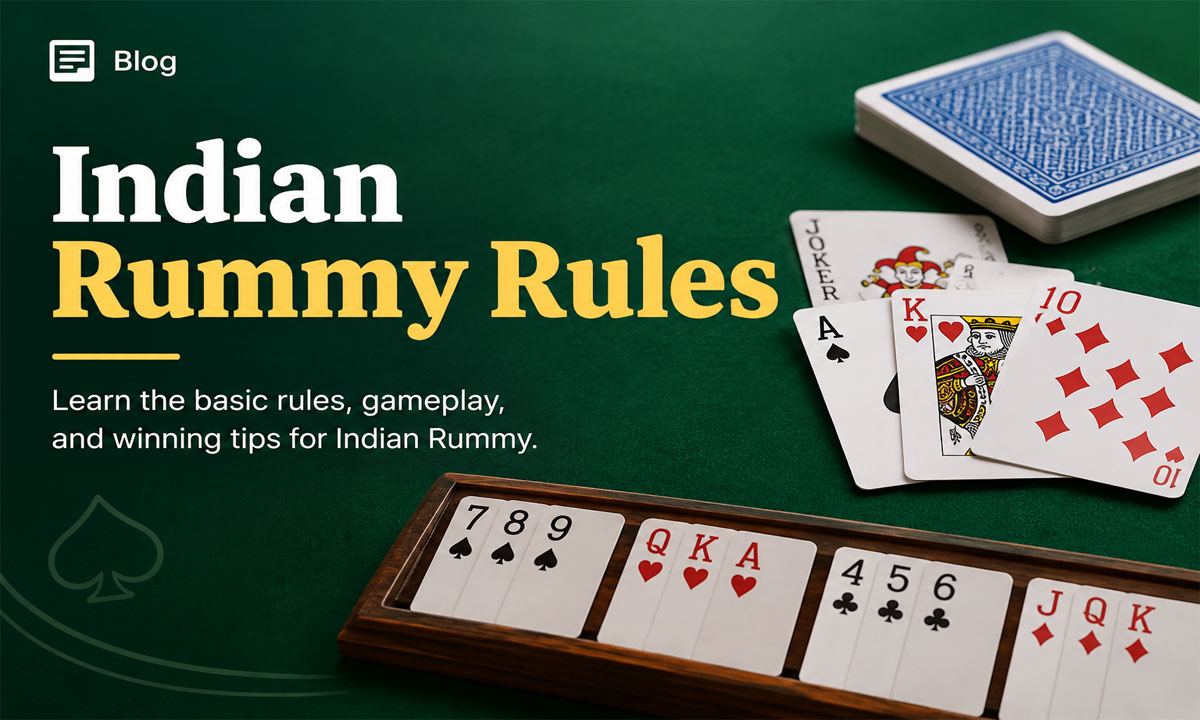
In this comprehensive guide, I will share my decade of experience as a card game expert. We will break down every rule, strategy, and insider tip you need to know. By the end of this article, you will be ready to confidently sit at any rummy table in India or Pakistan. Let’s shuffle the deck and get started!
- How to Play Indian Rummy Step-by-Step
- Rummy Rules for Beginners
- How Many Cards Are Dealt in India Rummy?
What is Indian Rummy?
Indian Rummy, frequently called “Paplu” in various regions, is a classic card-matching game. It is part of the draw-and-discard family of card games, much like Gin Rummy. However, Indian Rummy is unique because it is tailored specifically for the South Asian style of play.
Historically, rummy variations evolved over centuries, traveling from the West to the East. When it reached the subcontinent, players added their own local flavors. Therefore, the 13-card Indian variation was born, requiring more complex strategies and deeper analytical thinking.
Culturally, this game holds massive significance. It bridges generational gaps, allowing grand-parents and youngsters to compete on equal footing. Moreover, the recent boom in online gaming has introduced millions of new players to this beautiful game.
[Internal Link: The Fascinating History of Traditional South Asian Card Games]
Basic Rules & Requirements
Before you can master the strategies, you need to understand the foundational rules. Indian Rummy is typically played with 2 to 6 players at a single table. Because of the 13-card format, a single deck is simply not enough for larger groups.
For a standard game, you will need two standard decks of 52 cards each. Additionally, you must include two printed jokers in the mix. If you are playing with more than six players, a third deck is usually introduced.
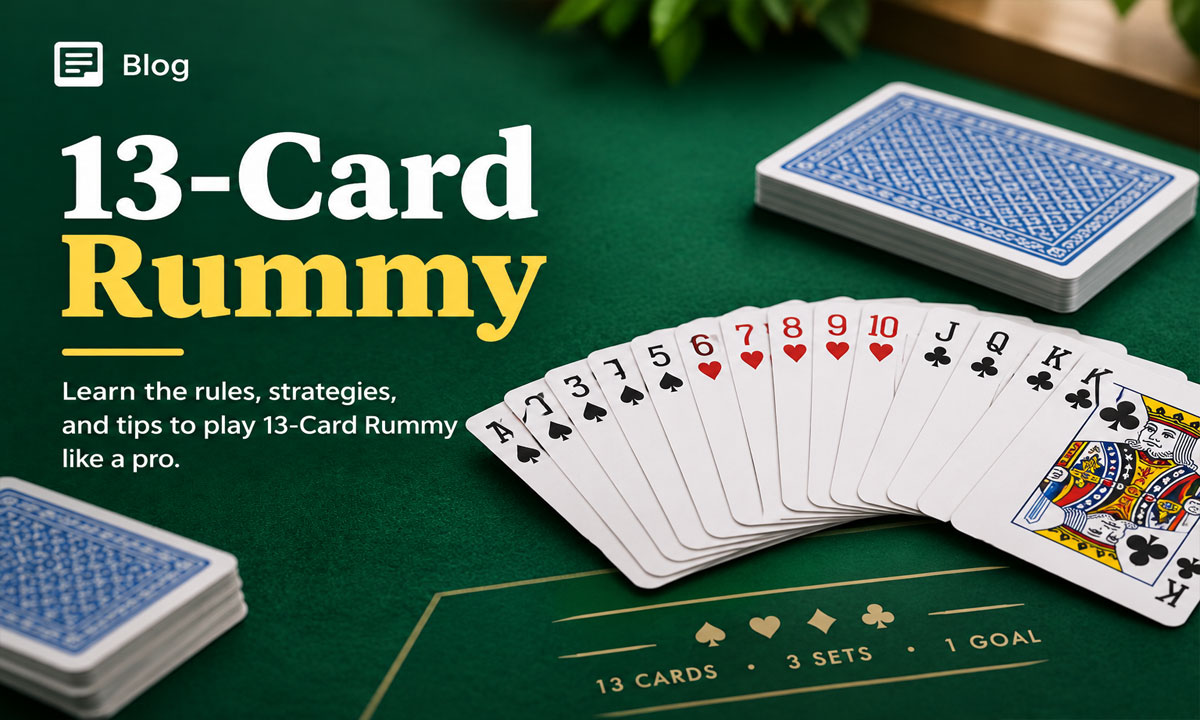
The primary objective of the game is quite simple to understand, yet challenging to execute. You must arrange all 13 cards in your hand into valid sequences and sets. Once you successfully group all your cards, you can declare your hand and win the round.
However, there is a catch. To make a valid declaration, you must have at least two sequences. Furthermore, at least one of these must be a “pure sequence,” which we will explain in detail later.
Card Values & Points System
Understanding the points system is crucial because, in rummy, points are bad. Your goal is always to keep your score at zero. If an opponent wins, your penalty points are calculated based on the ungrouped cards in your hand.
Here is a simple breakdown of the card values in Indian Rummy:
| Card Type | Cards Included | Point Value |
| High Cards | Ace (A), King (K), Queen (Q), Jack (J) | 10 Points Each |
| Numbered Cards | 2, 3, 4, 5, 6, 7, 8, 9, 10 | Face Value (e.g., 5 = 5 Points) |
| Jokers | Printed Jokers, Wild Jokers | 0 Points |
[Image Alt Text: A markdown table showing the card values and points in Indian Rummy]
In this game, the Joker is your best friend. There are two types of jokers: the printed joker that comes with the deck, and the wild joker. The wild joker is randomly selected at the beginning of each game.
For example, if the 7 of Hearts (7♥) is chosen as the wild joker, all 7s (7♠, 7♦, 7♣) become wild jokers for that round. They carry zero points and can substitute for any missing card to form sets or impure sequences.
How to Play Indian Rummy Step-by-Step
Now that you know the basics, let’s dive into the actual gameplay. If you want to know how to play Indian Rummy step-by-step, follow this chronological guide exactly.
Step 1: Setting Up the Game
First, gather your players around a comfortable table. Choose a dealer randomly by having everyone pick a card from a shuffled deck; the lowest card deals first. The dealer then thoroughly shuffles the two combined decks.
Step 2: Dealing the Cards
The dealer distributes exactly 13 cards to each player, one at a time, in a clockwise direction. Players should immediately pick up their cards and sort them. Most online platforms have an “auto-sort” button, but in real life, you must organize them by suit and color manually.
Step 3: Choosing the Wild Joker
Once all 13 cards are dealt, the dealer places the remaining cards face-down in the center. This stack becomes the “Closed Deck” or “Draw Pile.” Next, the dealer pulls one card from the closed deck and places it face-up underneath. This card dictates the Wild Joker for the entire round.
Step 4: Understanding Valid Sets & Sequences
Before making your first move, assess your hand. Look for consecutive cards of the same suit to form sequences. Simultaneously, look for cards of the same rank in different suits to form sets. Your immediate priority is always to build your pure sequence.
Step 5: Drawing a Card from Closed Deck or Discard Pile
The player sitting to the dealer’s left takes the first turn. You must start your turn by drawing one card. You can either blindly pick the top card from the Closed Deck, or take the visible top card from the Discard Pile.
Step 6: Discarding a Card
After drawing a card, you now have 14 cards in your hand. You must choose one card that is not useful to you and discard it face-up on the Discard Pile. Consequently, you always end your turn with exactly 13 cards.
Step 7: Declaring Your Hand (Show)
The game continues in a clockwise loop of drawing and discarding. Eventually, a player will successfully arrange all their 13 cards into valid melds. When this happens, they discard their final 14th card face-down (or into a finish slot) and declare “Show.”
Step 8: Valid Declaration Rules
Once a player declares, they must lay their cards open on the table for everyone to verify. A valid hand must contain at least one pure sequence and a second valid sequence (pure or impure). The remaining cards must be arranged in valid sets or sequences. If the hand is valid, that player wins the round with zero points.
[Internal Link: 10 Essential Rules Every Rummy Player Must Know]
Valid Sets and Sequences Explained
To truly understand how to play Indian Rummy step-by-step, you must master the art of making melds. A meld is simply a grouped combination of cards. There are three types of melds you need to know.
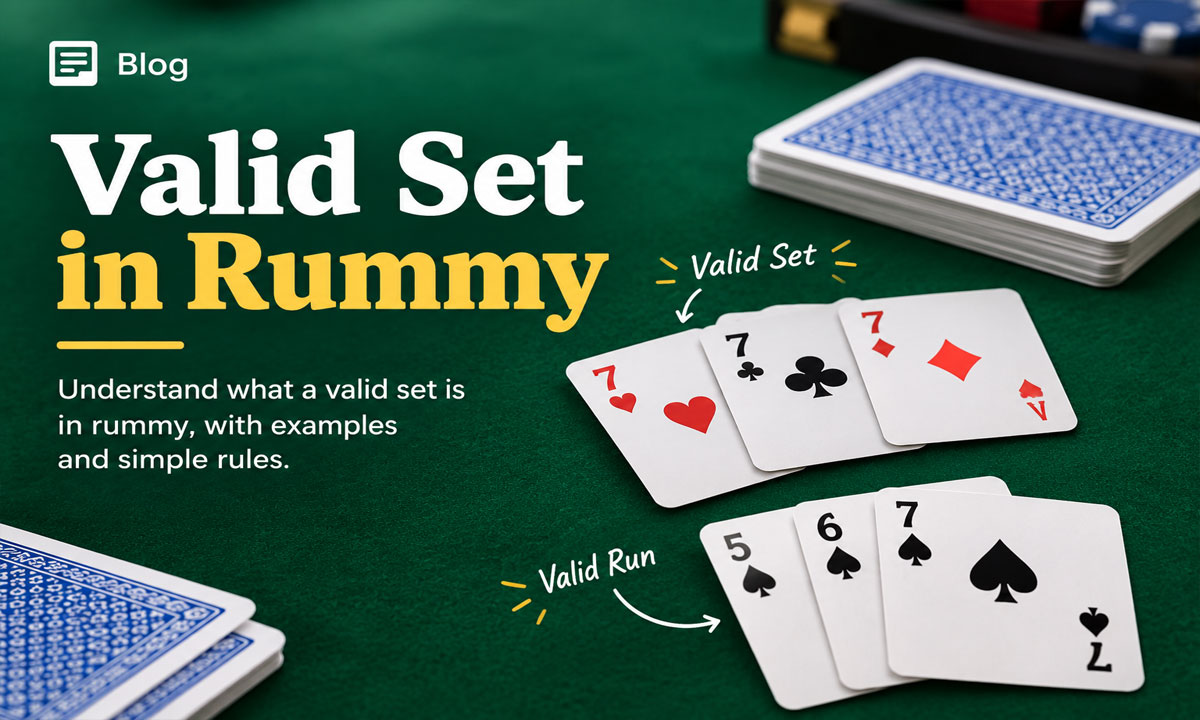
First, we have the Pure Sequence. This is a run of three or more consecutive cards of the exact same suit, without using any joker. For example, 5♠ 6♠ 7♠ is a pure sequence. This is the most critical meld because you cannot win without it.
Second, we have the Impure Sequence. This is also a run of consecutive cards of the same suit, but it utilizes a joker to fill a gap. For instance, if you have 8♥ and 10♥, you can use a Printed Joker to act as the 9♥. Therefore, 8♥ (Joker) 10♥ is a valid impure sequence.
Third, we have a Set. A set consists of three or four cards of the exact same rank, but completely different suits. For example, 4♠ 4♦ 4♣ is a valid set. You can also use a joker in a set, such as 9♥ 9♠ (Joker). However, you cannot use two cards of the same suit in a single set (e.g., 5♣ 5♣ 5♦ is invalid).
[Image Alt Text: Graphics showing examples of a pure sequence, impure sequence, and a set in Indian Rummy]
Scoring & Penalty Rules
As mentioned earlier, Indian Rummy uses a negative point system. The winner of the hand always receives zero points. Meanwhile, the losing players must tally up the penalty points of their unmelded cards.
If a losing player fails to form a pure sequence, their entire hand of 13 cards is counted as penalty points. However, to prevent massive losses, the maximum penalty a player can take in a single game is capped at 80 points.
Sometimes, you get dealt an absolutely terrible hand with no jokers and no sequences. In this case, you can use the “Drop” option. If you drop before picking your first card, it is called a “First Drop” and costs you a flat 20 points.
Conversely, if you play a few rounds and realize you cannot win, you can do a “Middle Drop.” Dropping out in the middle of the game will cost you 40 points. Knowing when to drop is a vital skill that saves you from taking the full 80-point penalty.
Common Mistakes Beginners Make
When learning how to play Indian Rummy step-by-step, beginners often fall into predictable traps. Recognizing these mistakes early will instantly elevate your gameplay.
- Ignoring the Pure Sequence: Many novices focus on making sets first. This is a fatal flaw. Always prioritize your pure sequence, because without it, your entire hand is counted as penalty points.
- Hoarding High-Value Cards: Beginners often hold onto Kings, Queens, and Aces hoping to form a sequence. Consequently, if an opponent declares early, they are stuck with massive penalty points. Discard unmatched high cards quickly.
- Not Watching the Discard Pile: Rummy is a game of observation. If you do not watch what your opponent is picking up or discarding, you might accidentally throw the exact card they need to win.
- Invalid Declarations: Declaring in a rush without double-checking your melds is a disaster. An invalid declaration automatically hands you an 80-point penalty and gives the win to your opponent.
Tips & Strategies to Win
As a seasoned player, I can tell you that winning consistently requires more than just knowing the rules. You need actionable strategies. The first tip is to arrange your cards by alternating colors. Group them as Red-Black-Red-Black. This visually separates your suits and prevents you from accidentally discarding a crucial card.
Secondly, master the art of “fishing.” This is a smart trick where you discard a card to bait your opponent into throwing the card you actually need. For example, if you have the 7♠, 8♠, and 10♠, discard the 10♠. Your opponent might think you do not need spades and safely discard the 9♠, which you can immediately pick up.
Additionally, utilize middle cards wisely. Cards like 5, 6, and 7 are incredibly versatile because they can easily form sequences in both directions. Conversely, end cards like Aces and Kings are harder to meld.
Finally, do not hold onto Jokers waiting for the perfect opportunity. Jokers are meant to be used to close out sequences and sets quickly. Use them aggressively to reduce your ungrouped cards, minimizing your risk if someone else declares suddenly.
[Internal Link: Advanced Rummy Strategies for Tournament Players]
Indian Rummy Variations
While the core rules remain consistent, South Asians love variety. Therefore, Indian Rummy has evolved into three primary tournament formats. Knowing these will help you choose the style that suits you best.
Points Rummy is the fastest and most popular version. Players compete for a pre-decided monetary value per point. The game lasts for only one deal. Whoever declares first wins the cash based on the opponents’ penalty points.
Pool Rummy is a longer, elimination-style format. It is usually played as 101 Pool or 201 Pool. Players are eliminated once their penalty points reach the 101 or 201 limit. The last player remaining at the table takes the prize pool.
Deals Rummy requires players to play a fixed number of hands, usually 2, 3, or 6 deals. Everyone starts with a set amount of chips. At the end of the predefined deals, the player holding the highest number of chips is crowned the winner.
Indian Rummy vs Pakistani Rummy
Card culture in India and Pakistan is incredibly similar, yet there are subtle house rules that differ. In India, the rules are heavily standardized today, largely thanks to the booming online rummy industry. The 13-card format is the undisputed king.
In Pakistan, while the 13-card game is widely played at home, players frequently incorporate localized “street rules.” For instance, some Pakistani households play a variation where the Joker cannot be used in a set, only in sequences.
Furthermore, games in Pakistan are often played purely for recreation during family gatherings, whereas in India, rummy has become a highly competitive, legally recognized game of skill played in massive online tournaments. Despite these minor differences, the shared love for the game unites both nations.
FAQ Section
Q1: Can I make a pure sequence with more than three cards?
Yes, absolutely! A pure sequence can contain four, five, or even six consecutive cards of the same suit. There is no limit, as long as no joker is used.
Q2: What happens if the Closed Deck runs out of cards?
If the draw pile is completely exhausted, the dealer will take the Discard Pile, shuffle it thoroughly, and place it face-down to form a new Closed Deck. The top card is turned over to start a new discard pile.
Q3: Is an Ace considered a high card or a low card?
In Indian Rummy, the Ace is versatile. It can be used as a high card alongside a King and Queen (Q-K-A). It can also be used as a low card alongside a 2 and 3 (A-2-3). However, it cannot loop around (K-A-2 is invalid).
Q4: Can I use two jokers in one meld?
Yes, you can use multiple jokers in a single impure sequence or set. However, remember that you must still have at least one pure sequence (no jokers) to make a valid declaration.
Q5: What is an invalid declaration?
An invalid declaration happens when a player says “Show” but their cards do not meet the mandatory requirements (e.g., missing a pure sequence, or making an invalid set). This results in an immediate 80-point penalty.
Q6: Is playing Indian Rummy online legal?
In India, the Supreme Court has declared Rummy a game of skill, making it legal to play for real money in most states. In Pakistan, real-money online rummy operates in a legal gray area, so most people stick to free-to-play social platforms.
Q7: Can I pick a discarded Joker?
No, according to standard Indian Rummy rules, if a player discards a Joker (printed or wild), the next player cannot pick it up from the discard pile. You must draw from the closed deck instead.
Q8: What is the difference between Gin Rummy and Indian Rummy?
Gin Rummy is typically played with 10 cards and only 2 players. Indian Rummy uses 13 cards, accommodates up to 6 players, and includes wild jokers, making the game longer and more complex.
Conclusion
Learning how to play Indian Rummy step-by-step is a journey of logic, patience, and strategy. At first, managing 13 cards and tracking your opponents’ moves might feel overwhelming. However, with a little practice, recognizing sequences and sets will become second nature to you.
Remember, the golden rule of rummy is to prioritize your pure sequence above all else. Once that is secured, you can boldly use your jokers and build the rest of your hand. Do not let bad cards discourage you; a smart player knows when to drop and save their points for the next round.
Now that you are equipped with the rules, tips, and strategies from this guide, it is time to shuffle up and deal. Invite your friends, set up a table, and enjoy one of the most intellectually stimulating card games South Asia has to offer. Happy playing!
3 Comment