










The main difference between a set and a sequence in Rummy is straightforward: a set is a group of three or four cards of the same rank but completely different suits (such as 8♥ 8♠ 8♦), while a sequence consists of three or more consecutive cards of the exact same suit (like 5♥ 6♥ 7♥). Sets focus strictly on matching the face value or rank across different suits. Sequences, on the other hand, focus on running order within a single suit.
Understanding this core distinction is your absolute first step toward mastering the game. Many new players across India and Pakistan struggle to remember which combination is which during fast-paced games. Mixing them up can lead to invalid declarations and massive penalty points.
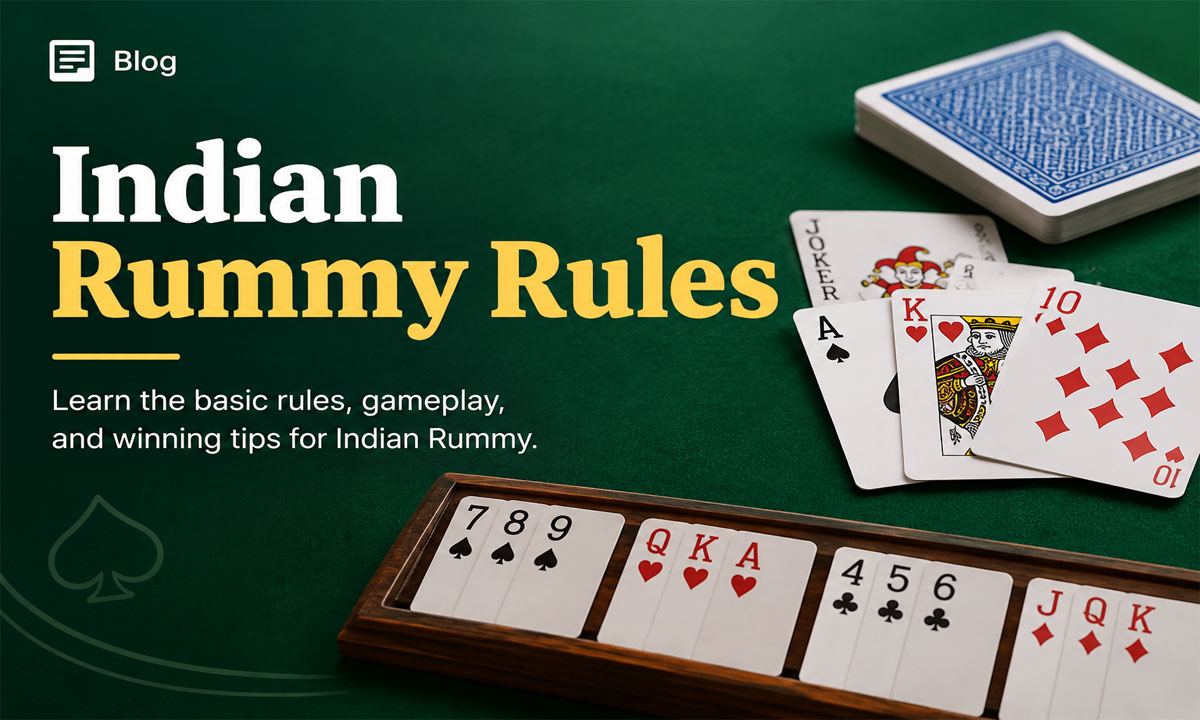
In this guide, I will act as your personal Rummy coach to break down these combinations clearly. We will explore valid examples, look at how jokers function in each, and provide actionable tips to build your hand faster. Let us dive in and clear up the confusion once and for all.
What is a Set in Rummy? A Quick Definition
A set is a valid grouping of cards that share the exact same number or face card value. However, every single card in this group must belong to a completely different suit. You cannot duplicate suits in a valid set.

You need a minimum of three cards to form a set. Since there are only four suits in a standard deck of cards (Hearts, Spades, Clubs, Diamonds), a natural set can only contain a maximum of four cards.
Sets are a fantastic way to group your leftover, unmatched cards. While they are incredibly useful for reducing your penalty points, they are entirely optional. You are not forced to make a set to win a game of 13-card Rummy.
What is a Sequence in Rummy? A Quick Definition
A sequence is a run of consecutive cards that share the exact same suit. Think of it like climbing a ladder; the numbers must follow each other in direct numerical order.
To form a sequence, you need at least three connected cards. For example, grouping the 10, Jack, and Queen of Spades creates a perfect sequence.
Unlike sets, sequences can be much longer. They can theoretically span all 13 cards in your hand if you are incredibly lucky. Furthermore, sequences are absolutely mandatory. You cannot declare a winning hand without them.
[Image Alt Text: A side-by-side visual comparison showing a set and a sequence on a traditional rummy card table]
Comparison Table: Set vs. Sequence
To make things crystal clear, here is a side-by-side comparison of the rules governing both combinations.
| Feature | Valid Set | Valid Sequence |
| Core Rule | Same rank, completely different suits. | Consecutive ranks, exact same suit. |
| Minimum Cards | 3 Cards | 3 Cards |
| Maximum Cards | 4 Cards (natural) | Up to 13 Cards |
| Suit Rule | Duplicates are strictly forbidden. | Must all belong to one single suit. |
| Are they Mandatory? | No, they are optional. | Yes, you must have at least two. |
| Example | 9♥ 9♠ 9♦ | 4♣ 5♣ 6♣ |
The Rank-Based Nature of Sets Explained
When we say a set is “rank-based,” we are talking about the face value of the card. In a standard deck, the ranks are 2 through 10, plus the Jack (J), Queen (Q), King (K), and Ace (A).
To build a set, your only focus is finding matching ranks. If you hold a 7 of Hearts, you are actively hunting for a 7 of Spades, 7 of Clubs, or 7 of Diamonds.
The consecutive order of the numbers does not matter at all when forming a set. A 7 does not connect to an 8 or a 9 in this scenario. You are strictly looking for identical twins in different clothing.
The Suit-Based, Consecutive Nature of Sequences
Sequences are entirely different beasts. When building a sequence, you must lock your focus onto a single suit. If you start building a sequence in Hearts, every natural card added to that group must also be a Heart.
Next, you must ensure the cards follow a strict ascending or descending order. The standard order is A, 2, 3, 4, 5, 6, 7, 8, 9, 10, J, Q, K, A.
Interestingly, the Ace is a versatile card. It can be used as a low card to form a sequence like A-2-3. It can also act as a high card to form Q-K-A. However, it cannot loop around; K-A-2 is strictly invalid in standard Rummy rules.
Pure Sequence vs. Impure Sequence
Before we look at specific examples, we must divide sequences into two critical categories. The first is a pure sequence. This is a run of consecutive cards of the same suit that uses absolutely zero jokers.
The second category is an impure sequence. This is also a run of consecutive cards of the same suit, but it uses a joker to substitute for a missing card.
Why does this matter? Because standard South Asian Rummy rules mandate that you must have at least one pure sequence to make a valid declaration. Without a pure sequence, your sets and impure sequences are completely useless, and you will take an 80-point penalty.
Valid Set vs. Invalid Set: Clear Examples
Let us look at how players in India and Pakistan often group their cards. We will analyze exactly why their sets are valid or invalid.
Rahul’s Turn: Rahul groups the King of Hearts (K♥), King of Spades (K♠), and King of Clubs (K♣).
Verdict: This is a valid set. It contains three cards of the exact same rank, and all three suits are completely different.
Ahmed’s Turn: Ahmed holds a 5 of Diamonds (5♦), a 5 of Spades (5♠), and picks up another 5 of Diamonds (5♦) from the closed deck. He groups them together.
Verdict: This is an invalid set. Ahmed used two Diamonds. Duplicate suits are strictly forbidden in any set.
Priya’s Turn: Priya groups a 10 of Clubs (10♣) and a 10 of Hearts (10♥). She declares her hand, assuming a pair is enough.
Verdict: This is an invalid set. A valid set must contain a minimum of three cards. A pair holds zero value in 13-card Rummy.
Valid Sequence vs. Invalid Sequence: Clear Examples
Now, let us examine how sequences are formed and where beginners commonly make mistakes.
Fatima’s Turn: Fatima organizes the 3 of Clubs (3♣), 4 of Clubs (4♣), and 5 of Clubs (5♣) together.
Verdict: This is a perfectly valid sequence. More specifically, it is a pure sequence because it uses no jokers and all suits match perfectly.
Rahul’s Mistake: Rahul groups the 7 of Hearts (7♥), 8 of Hearts (8♥), and the 9 of Diamonds (9♦).
Verdict: This is an invalid sequence. Rahul accidentally mixed a Diamond into his Hearts sequence. Every card in a natural sequence must share the exact same suit.
Ahmed’s Turn: Ahmed holds the Jack of Spades (J♠) and the King of Spades (K♠). He uses a printed joker to act as the missing Queen of Spades (Q♠).
Verdict: This is a valid sequence. Because he used a joker to fill the gap, it is classified as an impure sequence.
The Role of Jokers in Sets vs. Sequences
Jokers are the most powerful cards you can draw. In standard games, you play with two types of jokers: the printed joker and the randomly selected wild joker.
In a set, a joker simply replaces a missing suit. If you have the 4 of Hearts and 4 of Spades, you can add a joker. The game automatically assumes the joker is acting as the 4 of Clubs or Diamonds.
In a sequence, a joker fills a gap in the numerical order. If you have a 6 of Hearts and an 8 of Hearts, a joker placed between them will automatically act as the 7 of Hearts.
You can use multiple jokers in both sets and sequences. However, you must always have at least one natural card to anchor the rank or the suit of the group.
Why the 2-Sequence Rule Matters at Declaration Time
Understanding the difference between set and sequence in rummy is only half the battle. You must know how they fit into the final goal of the game: making a valid declaration.
To declare your hand and win the round, the rules require a minimum of two valid sequences. As mentioned earlier, at least one of these two mandatory sequences must be a pure sequence.
If you arrange all 13 of your cards into perfect sets, but fail to make any sequences, your hand is entirely invalid. Sets are secondary; sequences are your primary objective.
How Many Sets and Sequences Can You Use in a 13-Card Hand?
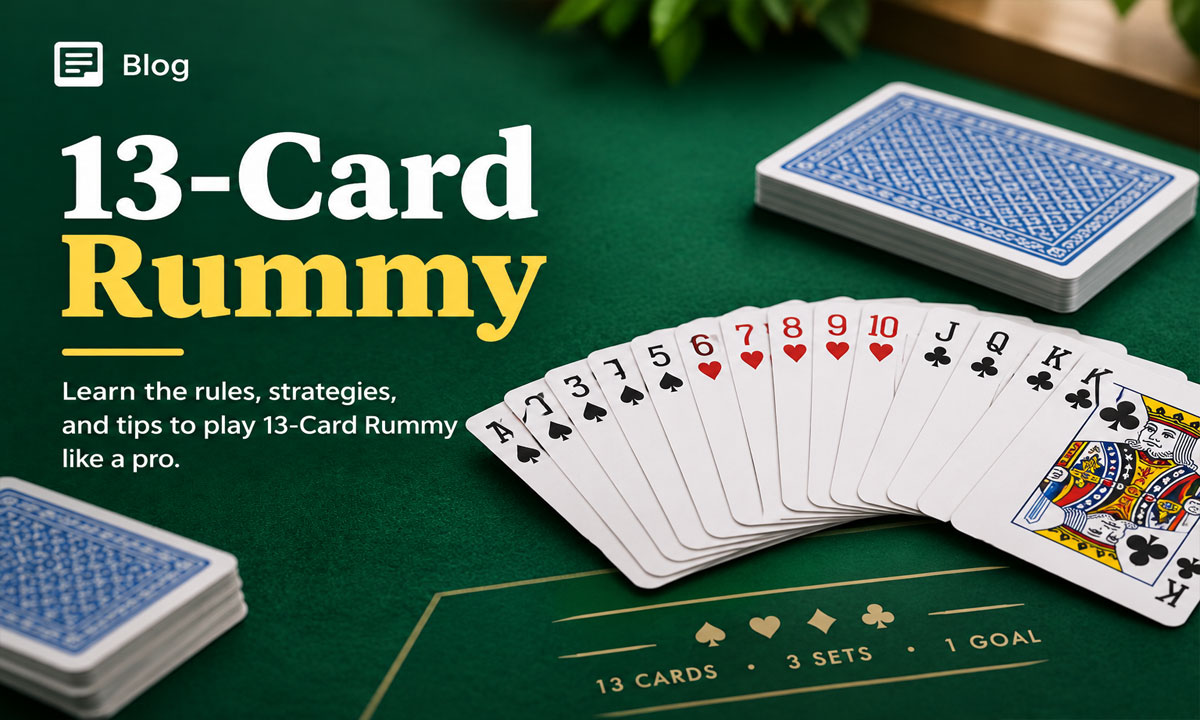
When you fan out your 13 cards, you are generally aiming to create four groups. The mathematically optimal grouping is three groups of three cards, and one group of four cards (3+3+3+4 = 13).
You can fulfill this requirement using a mix of sets and sequences. A very common winning hand consists of two sequences and two sets.
However, you can also win by forming four sequences and zero sets. You could even form two massive sequences (one of 6 cards and one of 7 cards). As long as you meet the minimum 2-sequence rule, the remaining cards can be grouped however you prefer.
Can a Set Replace a Sequence?
This is a question many beginners ask when they are struggling to find consecutive cards. The answer is a strict no.
A set can never replace your mandatory sequences. The rules explicitly demand sequential runs to prove your skill and observation.
If you are missing your second sequence, you cannot simply declare three sets and one sequence. Doing so will result in an invalid declaration and hand the victory to your opponents.
Common Beginner Confusions Between Sets and Sequences
Under the pressure of a ticking timer, beginners often blend the rules of both combinations together. Recognizing these errors early will save you a lot of frustration.
The most common error is forgetting the duplicate suit rule in sets. Because players are so focused on matching numbers, they forget to verify the suits. Always double-check your sets for duplicate suits before you hit the declare button.
Another frequent confusion is trying to loop an Ace in a sequence. Beginners often try to form King-Ace-Two (K-A-2). While the Ace connects to both the King and the Two independently, standard Rummy rules strictly prohibit looping them together in one sequence.
Practical Examples: “Is This a Set or a Sequence?”
Let us test your newly acquired knowledge with a quick quiz. Read the combination and determine what it is based on the rules we just covered.
Combination 1: 9♥, 9♠, 9♦, 9♣.
Answer: This is a perfectly valid 4-card set. All ranks match, and all four suits are completely unique.
Combination 2: 10♠, J♠, Printed Joker.
Answer: This is a valid impure sequence. The joker successfully substitutes for the Queen of Spades.
Combination 3: 7♥, 7♥, 7♣.
Answer: This is invalid. It is an illegal set because it contains two Hearts, violating the unique suit rule.
Combination 4: A♦, 2♦, 3♦, 4♦.
Answer: This is a valid pure sequence. It features consecutive numbers in the exact same suit with no jokers.
Tips to Build Sets and Sequences Faster During a Game
Building combinations quickly requires excellent organization. The very first thing you should do after the deal is sort your cards by alternating colors (Red-Black-Red-Black). This visual separation prevents you from accidentally grouping two red cards of the same suit.
Next, focus entirely on building your pure sequence. Do not get distracted by a pair of Kings. Your pure sequence is your lifeline; prioritize it above all else.
Finally, utilize middle cards wisely. Cards like 5, 6, and 7 are highly versatile. A 6 can connect with a 4 and 5, or an 8 and 7, to form a sequence. Hold onto middle cards slightly longer than rigid high cards like Aces and Kings.
Frequently Asked Questions (FAQ)
1. What is the absolute minimum number of cards for a set or sequence?
Both a valid set and a valid sequence require an absolute minimum of three cards. Two cards are simply a pair or a connected duo, which hold no declaring value.
2. Can I make a set with five cards?
In standard 13-card physical Rummy, a natural set is limited to four cards because there are only four suits. However, if you add a joker, some casual regional rules allow a 5-card set. Always verify the rules of the specific platform or house you are playing in.
3. Do I have to make a set to win?
No, sets are entirely optional. You can legally win a game by forming nothing but pure and impure sequences across your entire 13-card hand.
4. Can I use two jokers in one sequence?
Yes, standard rules allow you to use multiple jokers in a single impure sequence or set. However, a combination cannot consist entirely of jokers; you need a natural card to anchor it.
5. Why are duplicate suits not allowed in sets?
Because the game uses two decks, duplicate cards exist (e.g., two 8s of Hearts). If duplicates were allowed, forming sets would be too mathematically easy. The unique suit rule forces players to hunt for specific cards, increasing the game’s strategic difficulty.
6. Is an Ace a high card or a low card in a sequence?
An Ace is highly versatile. It can act as a low card to form A-2-3, or a high card to form Q-K-A. Just remember that it cannot loop around the deck.
Conclusion
Understanding the difference between set and sequence in rummy is the foundation upon which all winning strategies are built. By remembering that sets rely on matching ranks across different suits, and sequences rely on consecutive order within the same suit, you will easily avoid the most common beginner pitfalls.
Always prioritize building your pure sequence first, as it is the mandatory key to unlocking your declaration. Once that is secure, use your jokers aggressively to complete your impure sequences and sets.
Now that you have a firm grasp on how these combinations work, it is time to put your knowledge to the test. Sort your cards carefully, observe the discard pile, and enjoy mastering the beautiful, strategic game of Rummy!